SKIN CANCERS
Squamous cell carcinoma
SCC is a common skin cancer for which early diagnosis and treatment are important.
- Usually develops on sun-exposed skin
- May appear thickened, scaly or crusted
- Can develop from solar keratoses
- May spread if left untreated

Squamous cell carcinoma (SCC) arises from keratinocytes in the outer layer of the skin. It most commonly develops on chronically sun-exposed areas such as the face, ears, scalp, neck and hands.
Unlike basal cell carcinoma, SCC carries a higher risk of local invasion and, in some cases, spread to lymph nodes or distant organs.
Management depends on tumour size, depth, location, and individual risk factors.
The three most common types of skin cancer are melanoma, basal cell carcinoma and squamous cell carcinoma.
What does squamous cell carcinoma look like?
Squamous cell carcinoma can appear in several different ways. Common features include:
- Thickened red scaly patch
- Crusted or rapidly growing lump
- Non-healing sore
- Lesion that may be tender or painful

MBBS, MA (Virtual Comm), Grad Cert Hlth Info, Grad Dip Comp Inf Sci
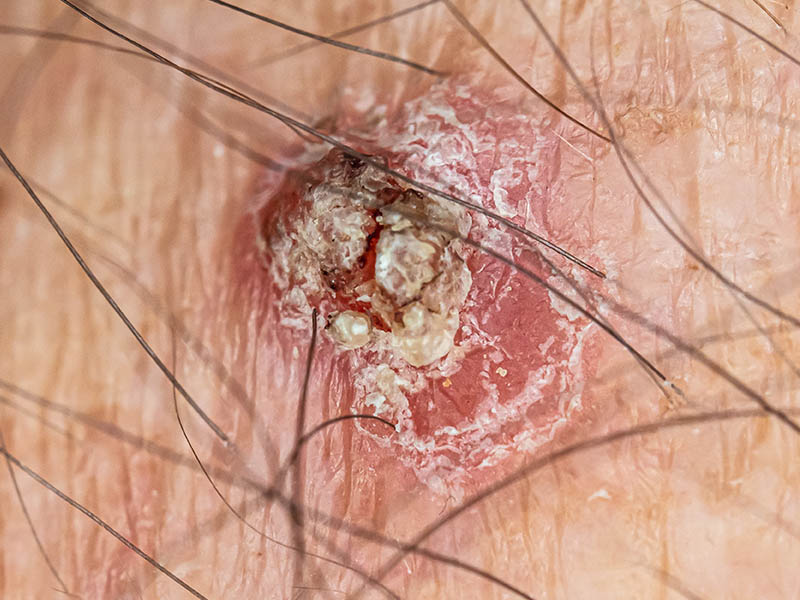
Squamous cell carcinoma: a crusted surface on a red patch of skin
Squamous cell carcinoma: a crusted surface on a red lump
How is squamous cell carcinoma diagnosed?
A doctor assesses the lesion, usually using dermoscopy. A biopsy or excision allows a pathologist to examine the tissue and confirm the diagnosis and depth.
What happens if SCC is untreated?
SCC can enlarge, ulcerate and invade deeper tissues. Some spread to nearby lymph nodes or distant organs. Large size, rapid growth, nerve involvement and immunosuppression can increase concern.
Treatment of invasive SCC
Invasive SCC is usually treated with surgical excision and appropriate margins. High-risk or complex lesions may require specialist referral, including consideration of Mohs surgery. Treatment depends on the pathology, size, depth, location and individual risk.
SCC in situ is different
Bowen’s disease (SCC in situ or intraepithelial carcinoma) is confined to the surface layer. Selected confirmed in-situ lesions may be treated with fluorouracil, fluorouracil/calcipotriol, cryotherapy or PDT. These surface treatments must not be assumed suitable for invasive SCC.
Risk factors
- Cumulative UV exposure and solar keratoses
- Fair skin and increasing age
- Immunosuppression
- Smoking, particularly for lip SCC
- Previous radiotherapy or solarium use
Reducing the risk
Regular skin checks support early detection of new or recurrent skin cancers.
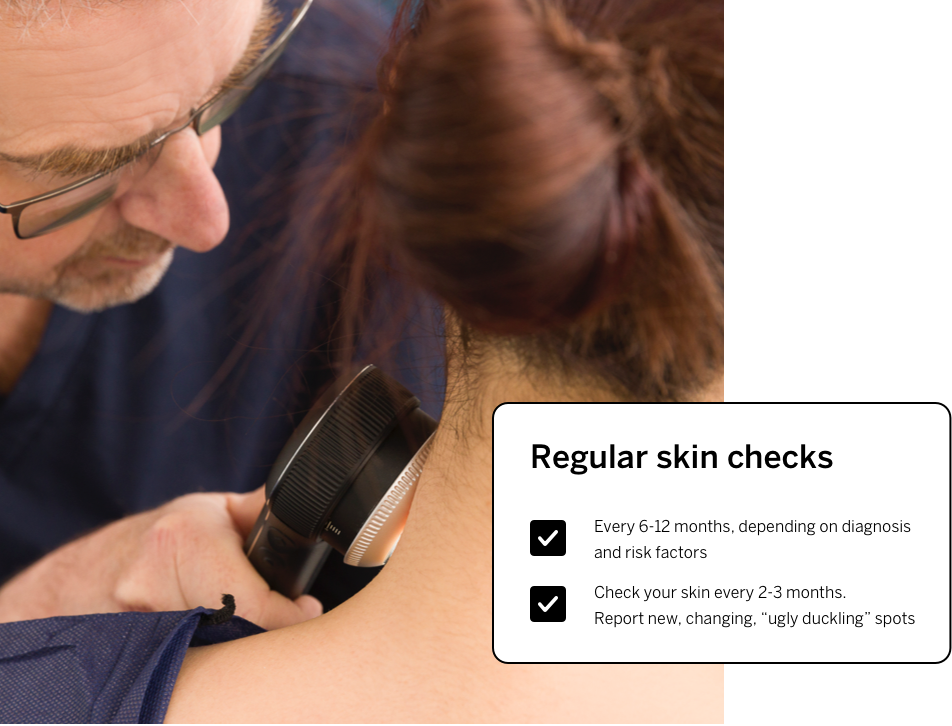
Your doctor will recommend an individual schedule for skin checks. Yearly review may be suitable for some people; previous multiple or high-risk skin cancers may need closer follow-up.
Solar keratoses can progress to squamous cell carcinoma. A very early form of SCC confined to the surface of the skin is known as Bowen’s disease.
Managing these lesions may reduce risk.
Treatment options for solar keratoses include cryotherapy, prescription creams, photodynamic therapy or fractional laser treatment for broader areas of sun damage.
Examine your skin every 2–3 months and report any new, changing or unusual lesions, particularly those that look different from others.
In selected high-risk patients, oral nicotinamide (vitamin B3 tablets) may reduce the development of new keratinocyte cancers.
Suitability should be discussed with your doctor.
Prevention
Primary prevention: for people who have never had a squamous cell carcinoma
Because most squamous cell carcinomas are caused by ultraviolet radiation, limiting excessive sun exposure is the most important preventive measure. Reducing UV exposure at any age may lower future risk.
When the ultraviolet index is greater than 3, recommended methods for reducing sun exposure include:
- Wearing long sleeves and pants, hats and sunglasses.
- Using broad spectrum sunscreen with SPF of 30 or greater.
- Seeking shaded locations.
Other measures to reduce SCC risk include:
- Avoiding or giving up smoking.
- Avoiding solarium use.
Related conditions
Some lesions may resemble squamous cell carcinoma or represent early stages of the disease.
• Bowen’s disease
• Basal cell carcinoma
References
- Cancer Council Australia 2016. Sunsmart national position statement: sun exposure and vitamin D – risks and benefits, in Cancer Council position statements
- Royal Australian College of General Practitioners 2018. Skin cancer, in “Red Book” guidelines for preventive activities in general practice
- Chen, Andrew C, et al 2015. A phase 3 randomized trial of nicotinamide for skin-cancer chemoprevention. The New England Journal of Medicine. 22 October 2015